The Aurelian Walls
Most travelers pass right by it on the tram without realizing they are staring at 2,000 years of layered engineering. Sitting at the intersection of the Esquilino and San Lorenzo neighborhoods, Porta Maggiore is one of the most fascinating points along the ancient Aurelian Walls—a place where imperial aqueducts, defensive fortifications, and everyday Roman transit clash head-on.
The Aurelian Walls: Rome’s Emergency Shield
By 271 AD, the Roman Empire was facing severe external threats. Emperor Aurelian ordered the construction of a massive, 19-kilometer (12-mile) brick-faced concrete circuit to encircle all seven hills.
To build fast, engineers took clever shortcuts: they incorporated existing structures directly into the defensive line. Amphitheaters, villa walls, and aqueduct arches were bricked up and converted into ramparts. That brings us to Porta Maggiore, which wasn’t built as a city gate at all.
Porta Maggiore: From Aqueduct to Fortress Gate
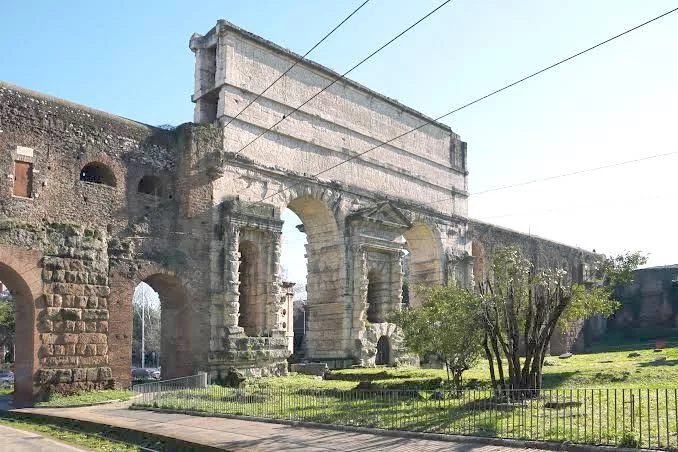
In 52 AD, Emperor Claudius built a massive double-arched monument made of white travertine to carry two vital aqueducts—the Aqua Claudia and the Anio Novus—over two major ancient roads: Via Prenestina and Via Casilina.
When Aurelian built his defensive wall 220 years later, his engineers simply absorbed Claudius’s aqueduct bridge into the new barrier, turning the archways into one of the city’s grandest entry portals.
-
The Attic Channels: Look up at the top of the gate. You can clearly see two stacked horizontal bands in the stone. These are the hollow channels through which water once flowed into the heart of ancient Rome.
-
The Baker’s Tomb: Just outside the gate sits the bizarre Tomb of Eurysaces, a wealthy freedman baker. His monument features giant cylinder cutouts (mimicking dough-kneading basins) and reliefs showing the ancient bread-making process. It survived only because later medieval fortifications encased it, protecting it until restoration workers pulled the medieval walls down in 1838.
Essential Visitor Info
| Detail | Info |
| Location | Piazza di Porta Maggiore, 00185 Roma RM |
| Best Transport | Tram 3, 5, 14, or 19 directly to Porta Maggiore stop |
| Cost & Access | Free public sight open 24/7 (viewable from street level) |
| Nearby Highlight | 10-minute walk to the Basilica di San Lorenzo fuori le Mura |
If you want to experience the Aurelian Walls without the crowds of the Colosseum, take Tram 3 toward San Lorenzo, hop off at the piazza, and spend twenty minutes exploring one of imperial Rome’s most impressive architectural mashups.